This article provides general informational guidance. See Legal Disclaimer.

In short: If a tool you already pay for gains an AI feature and your staff use it for work, your company is usually the deployer of that AI system under the EU AI Act, and the vendor the provider. Your own duties stay with you, whatever the vendor says about its compliance. Some apply today: AI literacy, the prohibited practices and part of the transparency rules. The heavier deployer obligations cover high-risk uses only, from 2 December 2027. GDPR applies as soon as the feature processes personal data.
The essentials in four points
- AI reached your tools through updates. Product releases, admin toggles and paid add-ons put AI into CRMs, HR systems, helpdesks and office suites, and most of it bypasses procurement.
- Your use decides your role. If your staff use an AI system for work, under your authority, the AI Act treats your company as a deployer, even if nobody chose the AI.
- Some uses make you the provider. Rebranding a high-risk system, modifying it substantially, or putting a general AI tool to a high-risk use, such as screening job applicants, moves the provider's obligations onto you.
- Start with the GDPR paperwork. Check whether your data processing agreement covers the new processing, whether the vendor has added a subprocessor, and whether you need a new impact assessment.
How AI arrives in your stack without a purchase decision
Vendors bring AI into your tools in three common ways: a release adds it to a product you already use, an administrator switches on a feature included in your licence, or a team buys a paid AI add-on. None of these feels like buying an AI system, so they skip the review a new supplier would get. Shadow AI is a different problem: there, employees use tools nobody approved. Here, you approved the tool and the vendor changed what it does.
Provider or deployer?
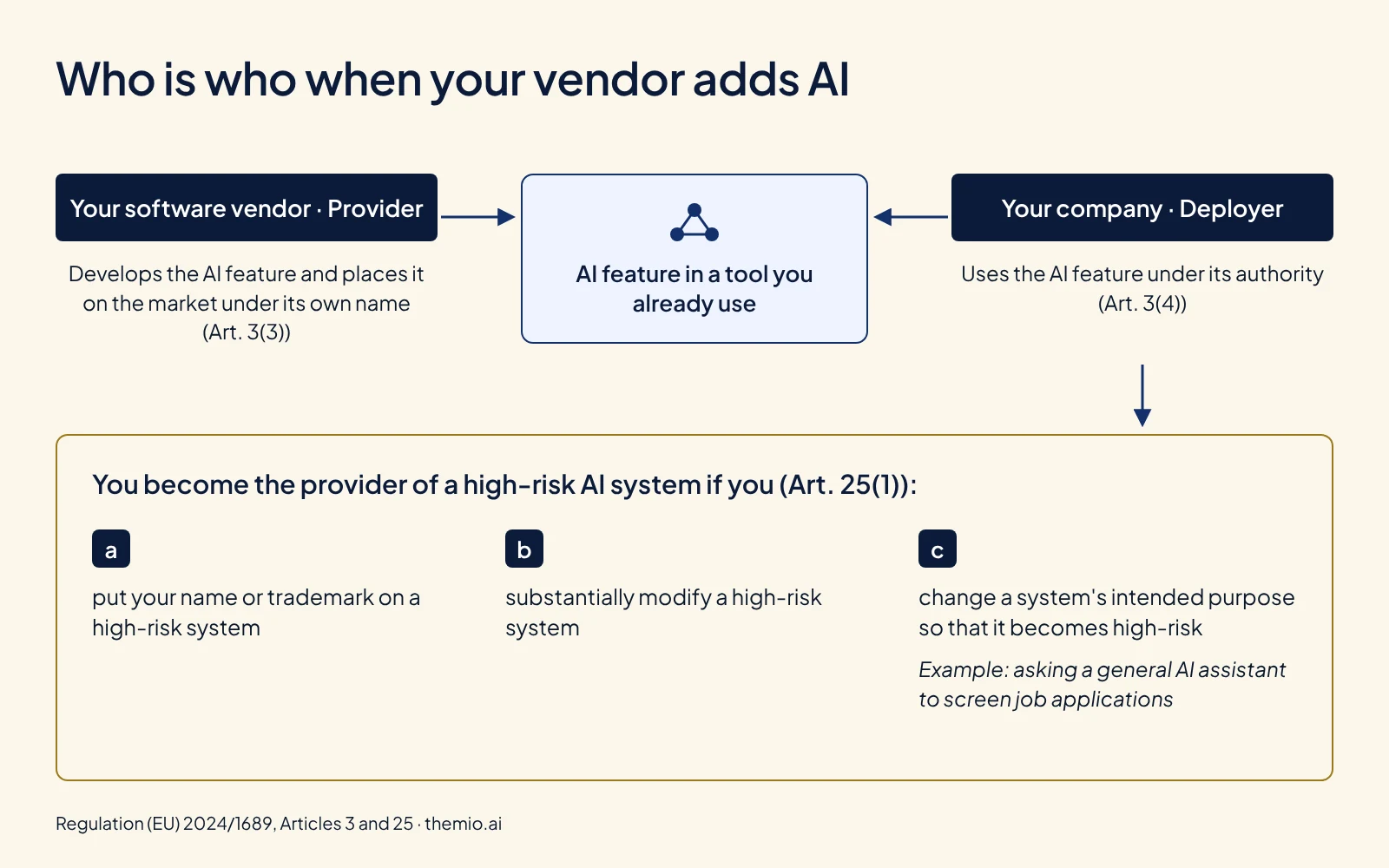
The AI Act assigns obligations by role. A provider is the organisation that develops an AI system, or has it developed, and places it on the market or puts it into service under its own name or trademark (Art. 3(3)). A deployer is any organisation “using an AI system under its authority”, except for purely personal, non-professional use (Art. 3(4)).
Your employees use the vendor's AI feature for their work, under your company's authority. The vendor and your company can therefore hold different roles for the same system, each with its own obligations.
| Situation | Vendor | Your company |
|---|---|---|
| Your CRM adds AI summaries of customer calls; sales staff use them | Provider | Deployer |
| You enable your helpdesk vendor's AI chatbot on your website | Provider | Deployer. Check that the “you are talking to an AI” notice is switched on and visible |
| You resell the vendor's AI feature to your own clients under your brand | Provider of the original system | You may be treated as the provider. Get specialist advice |
| You use a general-purpose AI assistant to rank job applicants | Provider of the general tool | You may become the provider of a high-risk system (see below) |
When you stop being “just a deployer”
Article 25(1) makes a deployer the provider of a high-risk AI system, with all the provider's obligations, in three situations:
- Name or trademark. You put your name or trademark on a high-risk AI system already on the market, unless contracts allocate the obligations otherwise.
- Substantial modification. You substantially modify a high-risk system and it remains high-risk.
- Change of intended purpose. You modify the intended purpose of an AI system not classified as high-risk, including a general-purpose AI system, so that it becomes high-risk.
SMEs fall into the third case most easily. Annex III, point 4(a), lists as high-risk the AI systems used in recruitment to “analyse and filter job applications” and to “evaluate candidates”. If you start asking a general writing or chat assistant to shortlist CVs, you may be changing that tool's intended purpose. The Act provides derogations, for example for narrow procedural tasks that do not materially influence a decision (Art. 6(3)). The facts decide whether one applies, and you may need legal or specialist advice.
What applies to you as a deployer, and when
| Obligation | Applies to deployers when | Since / from |
|---|---|---|
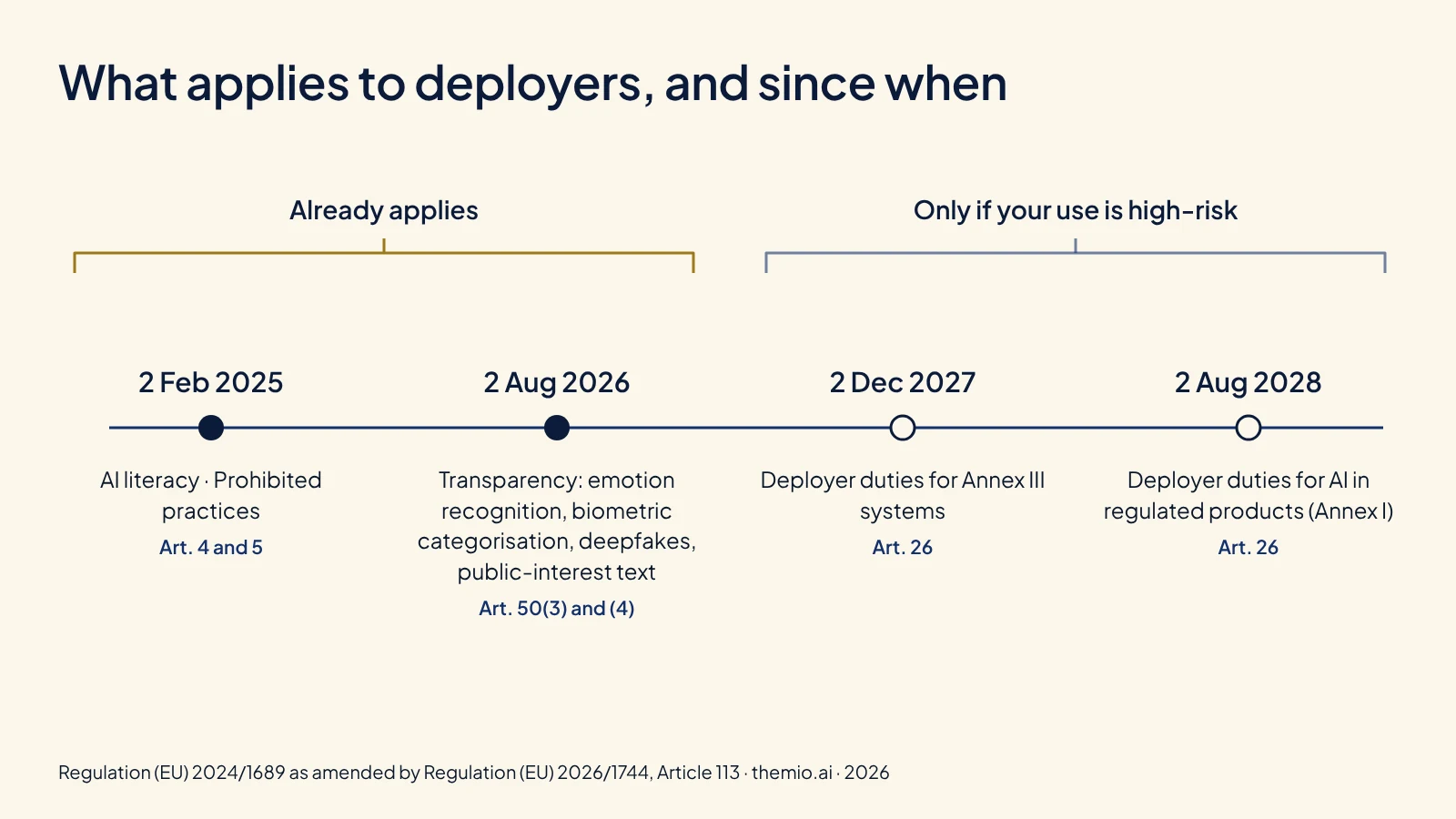
| AI literacy (Art. 4). Take measures to support the AI literacy of staff and others using AI on your behalf, adapted to their role and context. You do not have to guarantee any specific level. | Always | 2 Feb 2025 (current wording since 27 Jul 2026) |
| Prohibited practices (Art. 5). For example, inferring employees' emotions in the workplace, except for medical or safety reasons. A prohibited use stays prohibited when the vendor supplies the feature. | Always | 2 Feb 2025 |
| Emotion recognition or biometric categorisation (Art. 50(3)). Inform the people exposed to it. | If you use such a system | 2 Aug 2026 |
| Deepfakes and public-interest text (Art. 50(4)). Disclose deepfake image, audio or video that AI generated or manipulated. Disclose AI-generated text you publish to inform the public on matters of public interest, unless a person reviewed it or exercised editorial control and someone holds editorial responsibility for the publication. | If you publish such content | 2 Aug 2026 |
| High-risk deployer duties (Art. 26). Follow the instructions for use; assign competent human oversight; monitor operation and report risks or serious incidents; keep logs under your control for at least six months; inform workers' representatives and affected workers before using the system at work; inform people subject to decisions; use the provider's information for your GDPR impact assessment. | Only if your use is high-risk (e.g. Annex III) | 2 Dec 2027 (Annex III) / 2 Aug 2028 (product-embedded, Annex I) |
The December 2027 delay covers the high-risk regime only: literacy, prohibitions and transparency keep their original dates. Two Article 50 duties fall on the provider: telling people they are talking to an AI system (Art. 50(1)) and marking AI-generated content in a machine-readable format (Art. 50(2)). As deployer, check that your vendor has switched both on in your configuration.
The GDPR layer
A SaaS vendor that processes your customers' or employees' data on your behalf usually acts as your processor, and you remain the controller. A new AI feature can take that processing beyond what your current contracts and notices cover. Check three things:
- Your data processing agreement. The processor may process personal data only on your documented instructions (GDPR Art. 28(3)(a)). Check whether the agreement covers the new AI processing, and ask whether the vendor uses your prompts, documents or outputs to train or improve its own models. If it does, the contract should say so and set the terms.
- New subprocessors. AI features often rely on a third-party model provider. Under Art. 28(2), a processor needs your prior written authorisation before engaging another processor. If you gave a general authorisation, the vendor must tell you about changes and let you object. Look for that notice, and check where the new subprocessor processes data (GDPR Chapter V governs transfers outside the EEA).
- Impact assessment and notices. Article 35(1) requires a data protection impact assessment where processing, “in particular using new technologies”, is likely to result in a high risk to individuals. If the AI feature evaluates, scores or monitors people, run a fresh assessment. If purposes or recipients change, update your privacy notices too (Art. 13).
The EU's separate “Digital Omnibus” proposal would amend parts of the GDPR. EU institutions are still negotiating it in November 2026, so the current rules apply.
Ten questions to send your vendor
| # | Question | Why it matters |
|---|---|---|
| 1 | What exactly does the AI feature do, and what is its intended purpose? | Determines whether the use could be high-risk (AI Act Art. 6, Annex III) and whether your own use would change that purpose (Art. 25(1)(c)) |
| 2 | Is it on by default? Can an administrator switch it off, per team or per user? | Lets you limit use to approved purposes |
| 3 | Do you consider the feature high-risk under the AI Act? On what basis? | Your obligations depend on the classification |
| 4 | Which AI models and third parties process our data? Has your subprocessor list changed? | GDPR Art. 28(2) |
| 5 | Are our prompts, documents or outputs used to train or improve any model? Can we opt out? | GDPR Art. 28(3)(a): processing only on your instructions |
| 6 | Where is our data processed and stored? Is any of it transferred outside the EEA? | GDPR Chapter V |
| 7 | What instructions for use and documentation of known limitations do you provide? | Needed for human oversight, and required for high-risk use (Art. 26(1)) |
| 8 | What logs does the feature generate? Can we access, export and retain them? | Art. 26(6) for high-risk use; useful evidence in all cases |
| 9 | Are AI-generated outputs marked in a machine-readable format, and are AI-interaction notices enabled by default? | Provider duties under Art. 50(1) and (2), which shape what your users see |
| 10 | How will you notify us before adding or materially changing AI features? Can this go in the contract? | Gives you notice before the next change |
Five steps for this quarter
- Inventory. List AI features across the tools you already use, including those switched on by default. See our AI system inventory template.
- Assign roles. For each feature, record whether you are deployer only, or whether one of the Art. 25(1) triggers could make you a provider.
- Screen the uses. Flag anything touching recruitment, employee monitoring or evaluation, credit or access to essential services, and any workplace emotion inference, and review those in more depth.
- Close the paperwork gaps. Send the ten questions, update the data processing agreement and subprocessor approvals, and decide whether a new impact assessment is needed.
- Name an owner and support literacy. Give one person responsibility for AI features in purchased software, give users short, role-specific guidance, and keep a record of what you did and when.
Frequently asked questions
Where Themio fits
Themio is preparing AI Act and GDPR modules to help teams classify AI uses, check documents against the relevant articles and organise next actions, with each finding linked to its source.
Sources
- Regulation (EU) 2024/1689 (AI Act), consolidated version of 27 July 2026, EUR-Lex: Arts. 3, 4, 5, 6, 25, 26, 50, 113, Annex III
- Regulation (EU) 2016/679 (GDPR), EUR-Lex: Arts. 13, 28, 35, Chapter V
- Regulation (EU) 2026/1744 (Digital Omnibus on AI), EUR-Lex

This article provides general information on EU law as of 13 November 2026 and is not legal advice. Application to your situation, and national rules such as labour-law consultation requirements, may require review by qualified counsel.